Large Loss and Catastrophic Response in Meridian
Large loss and catastrophic response in Meridian and surrounding areas. IICRC-certified technicians, insurance billing accepted. Call (208) 713-3346.
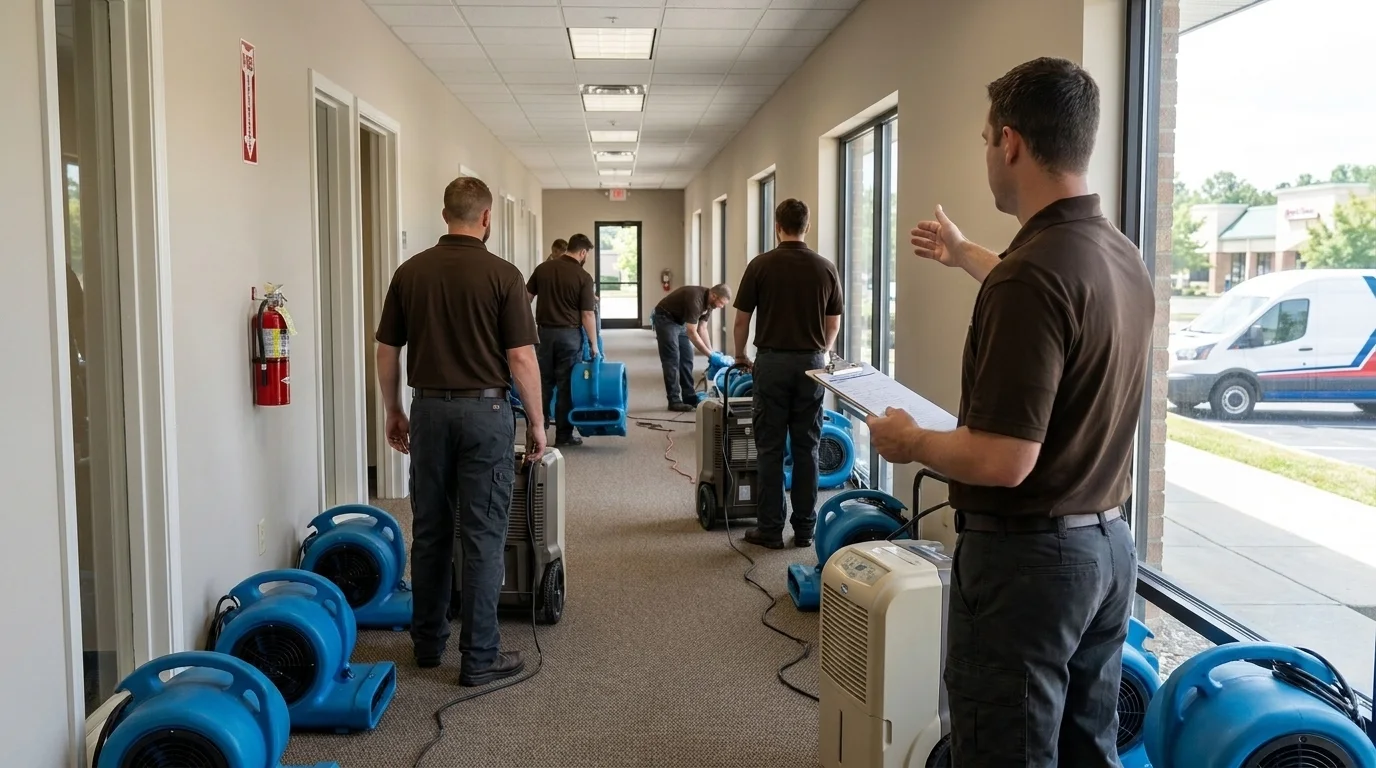
When a water main break floods three floors of an apartment complex, or a fire moves through a commercial building before the sprinklers catch it, the damage doesn’t behave like a single-room claim. Multiple trades need to mobilize at once, the insurance carrier assigns a large loss adjuster instead of a standard claims rep, and the dollar value climbs fast enough that every delay compounds the cost. Large loss and catastrophic response is built for exactly this scale of event, where a property manager, commercial owner, or general contractor needs one team coordinating mitigation across an entire structure or portfolio, not a crew working room by room.
What Large Loss and Catastrophic Response actually involves
A large loss is defined less by the cause of damage and more by its scale and complexity: multi-unit residential buildings, commercial or industrial facilities, properties with losses that cross six figures, or events affecting several structures at once (a storm system moving through a subdivision, for example). The work draws on the same core disciplines as a standard water, fire, or storm loss, but it has to run in parallel across a much bigger footprint. That usually means multiple extraction and drying crews working different sections of a building simultaneously, commercial-grade desiccant dehumidification running continuously for days or weeks rather than a few days with a couple of air movers, and a drying plan that accounts for different materials, different levels of saturation, and different occupancy schedules under one roof. Documentation volume is also much higher: moisture logs, photos, and equipment placement records need to cover every affected area, because large loss adjusters and their engineers review the file in detail before authorizing payment.
Our process
- Loss assessment and triage. We walk the full affected area, identify which sections need immediate mitigation to prevent secondary damage, and prioritize accordingly, structural stability and active water or fire sources come first.
- Crew and equipment mobilization. Large loss work means scaling up fast: additional technicians, extraction equipment, and commercial dehumidification get deployed to match the size of the loss, not a standard residential setup stretched thin.
- Direct coordination with adjusters and stakeholders. On a loss this size, we’re usually communicating with a large loss adjuster, a property manager, and sometimes a general contractor at the same time, so we keep scope, timeline, and documentation aligned across everyone involved.
- Phased mitigation and monitoring. Different zones of a large property dry at different rates. We track moisture content zone by zone with daily logs so drying decisions are based on data, not a guess at day five.
- Scope handoff for reconstruction. Once the structure is dry and stable, we document the completed mitigation and transition into reconstruction scope where rebuild work is needed.
What separates a good large loss response from a bad one
The most common mistake on a catastrophic loss is treating it like several small losses stacked together instead of one coordinated event. That leads to inconsistent drying logs, equipment that gets moved before an area is verified dry, and documentation gaps that slow down the claim. Large loss adjusters are trained to look for exactly this: do the moisture readings tell a consistent story from day one to completion, is there a clear equipment placement record, and does the scope match what was actually done on site. Another frequent gap is poor sequencing, pulling crews off a wet section too early to chase a more visible problem elsewhere, which lets secondary damage like swelling, delamination, or microbial growth set in behind the scenes. A response built for scale keeps one drying plan and one set of records for the whole property, even when several crews are working it at once.
What does Large Loss and Catastrophic Response cost?
Costs on a large loss vary enormously depending on square footage, number of units or structures affected, and how far the damage has progressed before mitigation starts, so any number here is a general industry range, not a quote. Idaho Disaster provides a written scope of work before mitigation begins so the property owner and the carrier are working from the same numbers. Commercial and homeowners policies typically cover sudden and accidental losses like burst pipes, storm damage, or fire, though coverage details and deductibles vary by policy and should be confirmed with the carrier.
| Scenario | Typical range |
|---|---|
| Multi-unit residential water loss (one building) | $50,000 - $250,000 |
| Commercial fire with structural damage | $100,000 - $500,000 |
| Industrial facility flood with equipment loss | $250,000 - $1,000,000+ |
| Storm damage across a multi-building property | $150,000 - $750,000 |
| Large-scale mitigation only (no rebuild) | $40,000 - $150,000 |
Seasonal & regional considerations
Treasure Valley winters bring freeze-thaw cycles that can split pipes in larger commercial buildings and multi-unit complexes all at once when a cold snap hits aging plumbing, turning what starts as a single burst pipe into a building-wide loss overnight. Spring runoff and heavy storm systems across the valley can also affect multiple properties in the same area in the same week, which is when having a team that can mobilize equipment and crews across several sites at once matters most.
Service area
Idaho Disaster handles large loss and catastrophic response across Meridian, Boise, Nampa, Caldwell, Eagle, Kuna, Star, Garden City, and Middleton, for commercial properties, multi-unit residential buildings, and industrial facilities throughout the valley.
If you’re managing a loss that’s bigger than a standard claim, a flooded building, a multi-unit fire, or storm damage across a property, call (208) 713-3346 to start mobilizing a coordinated response and get a written scope of work in motion.
Frequently Asked Questions
Does insurance cover large loss and catastrophic response?
What actually qualifies a loss as a "large loss" rather than a standard claim?
How is crew mobilization different for a catastrophic event compared to a single-room water loss?
What documentation do large loss adjusters expect that a standard claim doesn't require?
How long does mitigation take on a multi-unit or multi-million dollar loss?
Looking for the best large loss and catastrophic response company in Meridian?
Idaho Disaster provides large loss and catastrophic response in Meridian, ID and the surrounding area, and has served local property owners since 2026. We answer calls 24/7 — call (208) 713-3346 for immediate help.
Need Large Loss and Catastrophic Response now?
We respond 24/7 across Meridian and surrounding ID cities.